Combined depth · both venues
Loading both order books…
Yes 13.1%
Polymarket and Kalshi agree within 1 point on every outcome.
Fair chance strips out each venue’s built-in margin (its prices add up to more than 100%), then blends the venues by how much has traded there, so the outcomes add up to 100%. Best Yes price is the cheapest ask across venues, and the payout is what a winning $100 stake returns before fees. Open a row for each venue’s contract name, bid and ask, and how closely their rules match.
Prices come from our regular polls of each venue, the oldest 1 h ago. Ages are as of when this page was built.
Payoffs match in ordinary outcomes; see the rule differences below the table.
Indicative only, prices are 1 h old: No arbitrage: the best bid elsewhere is 13¢, at or below the cheapest ask of 17¢.
No cross-venue arbitrage right now: on every matched outcome, the best bid on one venue is at or below the cheapest ask on the other. Find markets with open spreads


Summarized from each venue’s published rules; the venue’s own rules page is the final word.
The leading outcome on both venues, with the consensus between them. Hover for exact values.
What it costs to buy Yes, what you would get selling it, and the last trade on each exchange, updating as orders change. Hover a status for timing details.
Each venue’s resting orders for the Yes contract, side by side. Top of book streams live; depth refreshes every 15 seconds.
Loading both order books…
Waiting for the first live quote…
Waiting for the first live quote…
Enter a stake to see where it buys the most after fees, using each venue’s live order book.
Loading both order books…
Loading every outcome’s book…
Buys at the asks resting now (taker orders), cheapest after fees first, from order-book snapshots up to 15 seconds old. Fees: Kalshi 0.07 × price × (1 − price) per share, rounded up to the cent; Polymarket 0.04 × price × (1 − price) per share (politics rate). Fee calculator. Estimates only, not advice.
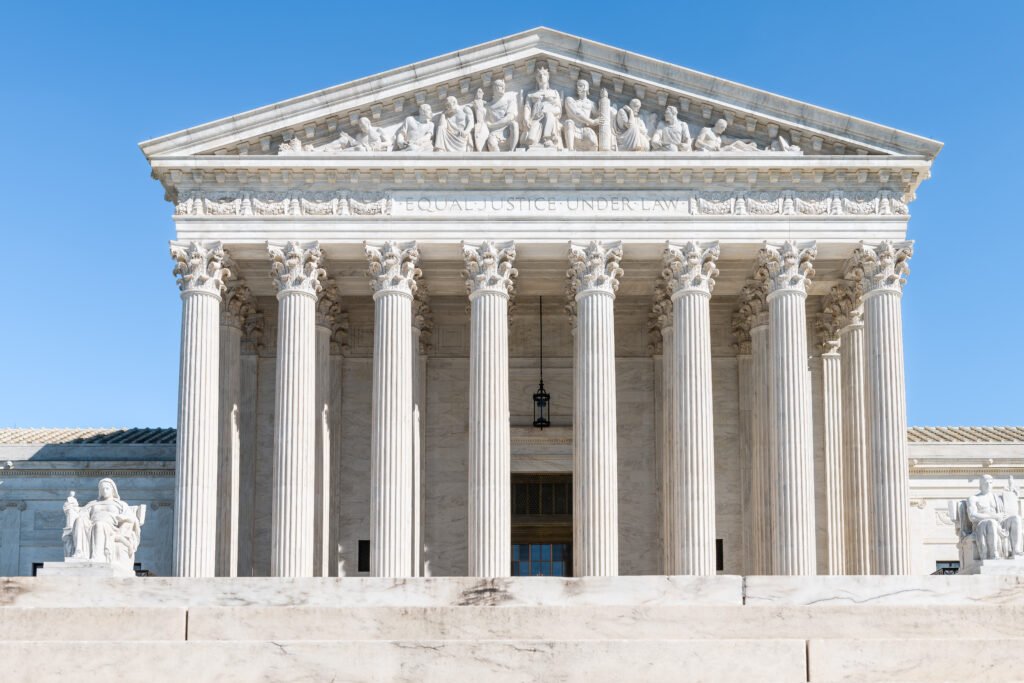
Live prediction market odds for "Supreme Court accepts AI copyright case before 2027?". Yes leads at 13.1%. $16K has traded across 1 outcome on Kalshi and Polymarket. The market is expected to resolve by Jan 1, 2027.
This market will resolve to "Yes" if the Supreme Court of the United States grants certiorari in a case concerning artificial intelligence and United States copyright law by December 31, 2026, 11:59 PM ET. Otherwise, this market will resolve to "No". A case qualifies if at least one of its claims or defenses, as described in the petition for certiorari or in the lower court's decision under review, concerns any of the following: (1) whether using copyrighted works to train, develop, or fine-tune an artificial intelligence model infringes copyright or is fair use; (2) whether outputs generated by an artificial intelligence model infringe copyright, or who is liable for such infringement; (3) whether works created in whole or in part by an artificial intelligence system are eligible for copyright protection, or who may be their author; or (4) any other claim under Title 17 of the United States Code, including the Digital Millennium Copyright Act, that arises from the training or development of an artificial intelligence model or from its outputs. An artificial intelligence model means any system that learns from data or generates content, including machine-learning and generative AI models such as large language, image, audio, and video models; the petition or decision does not need to use the words "artificial intelligence" or "AI". A grant limited to a procedural, jurisdictional, or remedial question in a qualifying case will count. A case in which an artificial intelligence developer is a party but no claim or defense concerns the matters listed above will not qualify. Granting certiorari means an order granting a petition for a writ of certiorari, including certiorari before judgment. An order that grants certiorari, vacates the lower court's judgment, and remands without further review (a GVR order) will not qualify. Denials of certiorari, orders inviting the Solicitor General to file a brief, relisting of a petition, and rulings on emergency applications or stays will not qualify. A qualifying case does not need to be pending before the Court at the time this market is created, and a qualifying grant will resolve this market to "Yes" even if the case is later dismissed, settled, or otherwise removed from the Court's docket. The grant must appear on the Supreme Court's official orders list or docket dated on or before December 31, 2026, 11:59 PM ET; the date of the Court's order governs, regardless of when reporting confirms it. The case does not need to be heard, scheduled, or decided by the deadline to qualify. The primary resolution source for this market will be official information from the Supreme Court of the United States (https://www.supremecourt.gov), including its orders lists and case dockets; however, a consensus of credible reporting may also be used.
It is the price of a Yes contract that pays $1 if the outcome happens. A 14¢ price means traders put the chance near 14%. Where two venues list the same outcome, we blend their last prices, weighting the venue with more trading volume more heavily (neither counts for less than a quarter). When only one outcome can win, each venue’s prices add up to a little over 100% (its margin); the fair chance removes that margin so the outcomes add up to exactly 100%.
A Yes contract pays $1 if it wins, so at the best ask a $100 stake buys 100 ÷ ask contracts. At 18¢ that is about 555 contracts, paying $556 (5.56x) if Yes happens. Venue fees and price slippage on larger orders are not included.
Each venue has its own traders, fees and order book. Contracts can also settle on slightly different terms, which is why each row lists how closely the rules match.
Only when you can buy Yes on one venue below what someone pays for Yes on the other, after fees, and both contracts settle the same way. We show the executable bid and ask so you can check.
Venue prices refresh every few minutes, and the order book and live quotes stream continuously. Each venue’s card shows when we last observed it.